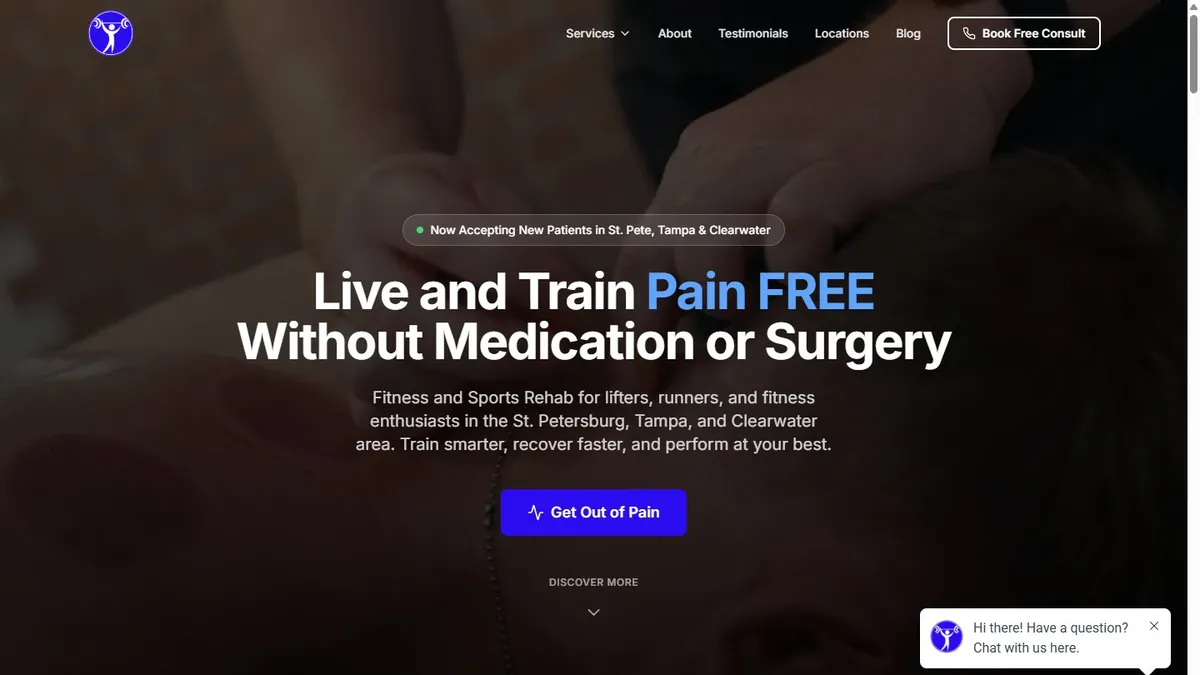
A physical therapy clinic's website is unlike any other service business site. Patients arriving on the page are often in pain, navigating insurance for the first time, comparing 3-4 clinics, and looking for very specific reassurance: "Will this clinic actually help me, will they take my insurance, and can I book an appointment without a 20-minute phone call?" Most PT websites answer none of those questions well.
This guide breaks down what a high-converting PT website looks like in 2026: HIPAA-aware online booking, treatment pages that rank for the conditions patients actually search for, the trust signals that healthcare buyers need to see before they commit, and the local SEO foundation that gets you in front of injured people searching from their phone. We'll also walk through how our work with Forward Physio drove a 150% increase in online appointment bookings.
What PT Patients Look For Online
PT patients aren't shopping for a fun experience. They're looking for resolution to a real problem—a torn ACL, post-surgical recovery, chronic back pain, vestibular issues, a kid with a sports injury. The mental state of the searcher shapes every design decision. A great PT website meets them where they are: anxious, uncertain, and time-pressured.
The 5 Questions Every PT Patient Has
- "Do you treat my specific condition?" A patient searching "PT for rotator cuff tear" needs to see "Rotator Cuff Rehabilitation" as a named treatment, not buried under "Orthopedic PT"
- "Do you take my insurance?" Insurance acceptance is the #1 disqualifier. List every plan you accept, prominently, with a way to verify in-network status before they commit
- "How quickly can I be seen?" Patients in pain don't want to wait 3 weeks. Show next-available appointment times when possible
- "What will it cost?" Even ballpark ranges for self-pay or out-of-network estimates build trust. Silence implies surprise bills
- "Are these therapists actually good?" Credentials, specializations, reviews, and a real "Meet the Team" page (with photos and bios) make the difference
The Anxiety Reduction Principle
Healthcare web design is fundamentally about reducing anxiety at every step. A patient who feels reassured by your homepage, calmed by your insurance page, and confident from your therapist bios will book. A patient who feels lost, uncertain, or frustrated will close the tab.
HIPAA-Aware Forms & Online Booking
Healthcare websites have a unique compliance constraint: any form that collects Protected Health Information (PHI) must be HIPAA-compliant. This shapes how you handle online booking, intake forms, and even contact forms that might inadvertently collect medical details.
What Counts as PHI
PHI is any individually identifiable health information—name plus condition, name plus appointment for a specific treatment, name plus insurance ID, name plus injury details. A simple "Book an appointment" form that captures a patient's name and the reason for visit is collecting PHI and must be HIPAA-compliant.
The HIPAA-Compliant Booking Stack
- Use a HIPAA-compliant booking platform. Options include Jane App, SimplePractice, Klara, NexHealth, Mend, and WebPT. All offer signed Business Associate Agreements (BAAs)
- Avoid generic form tools without a BAA. Default Typeform, Google Forms, and most WordPress contact form plugins are NOT HIPAA-compliant for PHI collection
- Encrypt everything in transit and at rest. HTTPS (TLS 1.2+) is non-negotiable. Your booking platform should encrypt data at rest as well
- Set up access controls. Only authorized staff should access patient data. Audit logs should track who accessed what and when
- Train your team. Compliance isn't just technical—staff need to know how to handle PHI in email replies, voicemails, and text messages
- Get the BAA. Every third-party vendor that touches PHI (booking platform, email provider, hosting, CRM) must sign a Business Associate Agreement. No BAA = no PHI sharing
The Compliance ≠ Friction Mistake
Many PT clinics over-correct on compliance and end up with booking flows that feel like applying for a mortgage. The goal is compliant AND simple: a HIPAA-compliant booking platform that lets a patient select a service, see open times, and confirm in under 2 minutes—with intake forms sent securely after the booking is made, not before.
Treatment Pages That Rank & Convert
Patients search for conditions, not categories. They search "physical therapy for plantar fasciitis," not "orthopedic physical therapy." Your website needs a dedicated, deeply optimized page for every major condition you treat—both to rank for those long-tail keywords and to reassure patients you actually treat what they have.
What a High-Converting Treatment Page Includes
- Clear H1 naming the condition: "Physical Therapy for [Condition] in [City]"
- Brief description of the condition (2-3 sentences, written for patients not clinicians)
- Common symptoms and causes so patients self-identify
- Your treatment approach for this specific condition—not generic "we do exercises"
- Expected treatment duration and outcomes ("most patients see relief in 6-8 visits")
- A relevant patient testimonial ideally for the same condition
- FAQs: "Is PT painful?" "How many sessions will I need?" "Do I need a referral?" "Will my insurance cover this?"
- A clear booking CTA repeated at the top, middle, and bottom of the page
Treatment Pages Every PT Clinic Should Have
At minimum: Back Pain, Neck Pain, Shoulder Pain, Knee Pain, Hip Pain, Post-Surgical Rehab, Sports Injury, Sciatica, Plantar Fasciitis, Vestibular/Vertigo, Pelvic Floor PT (if offered), Pediatric PT (if offered), and Concussion Rehab. Each condition page is a separate ranking opportunity. A clinic with 15 condition pages typically ranks for 5-10x more search queries than a clinic with only generic service pages.
The 'In [City]' Multiplier
Adding your city name to the H1 and meta of each treatment page is the single fastest way to capture local search intent. "Physical Therapy for Sciatica in Manchester NH" ranks far faster and more specifically than "Sciatica Treatment." Specificity beats volume in healthcare search.
Trust Signals That Win Patients
Healthcare has the highest trust threshold of any consumer category. A patient choosing a PT clinic is essentially saying "I will let you touch my injured body and influence my recovery." The trust signals on your website determine whether they say yes to you or to the clinic down the street.
The Trust Signal Stack
- Detailed therapist bios with photos. Real faces, real credentials (DPT, OCS, PCS, SCS, board certifications), years of experience, and 1-2 sentences of personality. Generic stock photos kill trust
- Specialization badges. If a therapist specializes in sports medicine, vestibular rehab, or pelvic floor PT—name it prominently. Patients seek out specialists
- Insurance logos. Display the logos of major plans you accept. Visual recognition is faster than reading a list
- Real patient testimonials with names and conditions treated. "Sarah M., Knee Surgery Recovery" beats anonymous quotes
- Google reviews embedded. Live, recent reviews with star count visible on the homepage
- Clinic photos. Real photos of your space, equipment, and team in action. Stock photos of generic gyms feel impersonal
- Educational content. Blog posts, videos, and free guides on common conditions establish expertise
- Awards and affiliations. APTA membership, hospital partnerships, sports team affiliations, community recognition
Accessibility = Trust
An accessible website (WCAG-compliant, keyboard-navigable, screen-reader friendly) isn't just a legal box to check—it's a trust signal. Patients with disabilities, vision impairments, or cognitive challenges actively seek healthcare providers who build accessible experiences. See our ADA & WCAG Compliance Guide for the full checklist.
Local Healthcare SEO
Healthcare SEO is local SEO with extra considerations. Patients search from a specific area, often on mobile, often in pain, often urgently. The clinics that win are the ones whose Google Business Profile, condition pages, and trust signals all align around local intent.
The PT Local SEO Foundation
- Google Business Profile fully optimized: Primary category "Physical Therapy Clinic" or "Physical Therapist," services listed (each treatment as a service), 50+ clinic photos, accurate hours, posts weekly
- Healthcare-specific directories: Healthgrades, Vitals, WebMD, Zocdoc, and any insurance-specific provider directories (Blue Cross, Aetna, UHC find-a-doctor tools)
- MedicalBusiness schema: A more specific subtype of LocalBusiness schema. Tells Google you're a healthcare provider and unlocks healthcare-specific rich results
- Condition + city pages: "Sciatica Treatment in [City]" pages capture high-intent local search faster than generic treatment pages
- Patient reviews velocity: Healthcare reviews are harder to generate (HIPAA constrains how you can ask), but every Google review is worth more in healthcare than in most verticals
- Doctor and referrer backlinks: Get listed on the websites of orthopedic surgeons, primary care physicians, sports medicine doctors, and chiropractors who refer to you. These are the highest-authority backlinks a PT clinic can earn
The Insurance Page is an SEO Page
Most PT clinics treat their "Insurance" page as an afterthought. But a well-built insurance page that lists every accepted plan + the cities you serve ranks for dozens of "[plan name] physical therapy in [city]" searches—an extremely high-intent query. Don't waste this page.
Real Result: Forward Physio
When Forward Physio partnered with us, they had a clean clinic, a passionate team, and a website that was actively losing them patients—buried insurance information, no online booking, generic stock photos, and treatment pages that read like a clinical textbook.
What We Rebuilt
- Custom HIPAA-compliant online booking integrated with their EMR
- Insurance acceptance prominently displayed with logos and verification flow
- Photo shoot featuring real therapists in the actual clinic space
- Dedicated treatment pages for each major condition (back pain, post-surgical, sports injury, vestibular, pelvic floor)
- Therapist bio pages with specializations, credentials, and personality
- Patient testimonial system organized by condition treated
- Full local healthcare SEO including MedicalBusiness schema and condition-specific city pages
What Happened
150% increase in online appointment bookings within the first six months.
Front desk phone time reduced ~30% as patients booked themselves online instead of calling.
First-page rankings for "physical therapy in [city]" and 8 different condition-specific local keywords within 9 months.
Patient acquisition cost dropped 40% as organic search delivered consistent new-patient flow.
The Front Desk Effect
The unsung win of a great PT website is the time it gives back to your front desk team. When patients book themselves, verify insurance themselves, and complete intake forms online, your front desk gets to focus on in-person patient experience—the thing that actually drives retention and referrals.
Physical therapy is one of the highest-stakes service categories online. Patients are choosing who will help them heal. The clinics that win are the ones whose website meets the patient where they are: reduces anxiety, answers the real questions, makes booking easy, and proves clinical competence at every step.
Building a PT Website That Wins Patients?
At Heck of a Website, we specialize in website design for physical therapy clinics. From HIPAA-aware booking to local healthcare SEO, we build sites that respect the unique trust threshold of healthcare buyers. Schedule a free consultation to discuss your clinic—or read our Forward Physio case study for the full story.