At some point, every growing business hits a wall with their existing tools. Spreadsheets get unwieldy. Generic software doesn't quite fit your workflow. You're paying for five different subscriptions that barely talk to each other. That's when the question comes up: should you invest in custom software or stick with off-the-shelf solutions?
The answer isn't always obvious—and it's rarely one-size-fits-all. This guide breaks down both options honestly, with real cost comparisons and use cases to help you make the right decision for your business.
Understanding Your Options
Before diving into which is better, let's clearly define what we're comparing. Both approaches have legitimate strengths, and the right choice depends on your specific business needs, budget, and growth trajectory.
Custom Software
Purpose-built applications designed specifically for your business processes, workflows, and requirements. You own the code, control the features, and shape the roadmap.
- Examples: Custom CRM, fleet management platform, client portal, inventory system
- Built by: Software development agencies or in-house developers
- Timeline: 2–6+ months to build, ongoing maintenance
- Ownership: You own the code and data completely
Off-the-Shelf Software
Pre-built applications designed for broad market use. They work out of the box but may require workarounds for unique business needs.
- Examples: Salesforce, QuickBooks, HubSpot, ServiceTitan, Jobber
- Built by: SaaS companies serving many businesses
- Timeline: Days to weeks for setup and configuration
- Ownership: You rent access; vendor controls the platform
When Custom Software Makes Sense
Custom software isn't for everyone, but when it's the right fit, it can be transformative. Here are the scenarios where building custom delivers clear advantages over buying off-the-shelf.
6 Signs You Need Custom Software
- Your workflow is unique: If your business processes don't fit neatly into any existing software category, forcing them into a generic tool creates friction and workarounds that slow your team down
- You're outgrowing your tools: When you're using 5+ different tools with manual data transfer between them, a single custom platform that unifies everything can save hours daily
- Competitive advantage matters: If your software IS your competitive edge (like a proprietary booking system or customer portal), you can't afford to use the same tool as your competitors
- Data ownership is critical: In industries with compliance requirements or sensitive data, owning your infrastructure gives you full control over security and privacy
- You need specific integrations: When off-the-shelf tools don't integrate with your existing systems (accounting, scheduling, equipment tracking), custom APIs solve the problem permanently
- Scale is on the horizon: If you're planning to franchise, license your process, or scale significantly, custom software scales with you without per-seat pricing eating into margins
The Integration Tax
Many businesses don't realize that connecting 4–5 SaaS tools through Zapier or manual exports costs real money and time. When you add up subscription fees ($200–$500/month each), integration tool costs, and the staff time spent managing data flow, custom software often becomes cost-competitive much sooner than expected.
When Off-the-Shelf Is the Better Choice
Custom software isn't always the answer. For many businesses, especially those in early growth stages, off-the-shelf tools are the smarter, more pragmatic choice. Here's when to buy instead of build.
6 Signs Off-the-Shelf Is Right for You
- Standard workflows: If your business follows industry-standard processes (invoicing, scheduling, basic CRM), proven tools like QuickBooks or Jobber do it well and affordably
- Limited budget: If you're a startup or small business with under $10K for software, off-the-shelf tools let you get started immediately without a major upfront investment
- Speed to market: When you need a solution today, not in 3–6 months, SaaS tools can be configured and running within days
- Established best practices: Tools like ServiceTitan for HVAC or Jobber for field service have been refined by thousands of businesses—you benefit from their collective learning
- Small team: If you have fewer than 10 employees and standard needs, the overhead of maintaining custom software may not be justified
- Proven category: For accounting, email marketing, and project management, the market leaders are mature, reliable, and cost-effective
The key is being honest about whether your needs are truly unique or just feel unique. Many businesses think they need custom software when a well-configured off-the-shelf tool with a few automations would solve 90% of their problems at a fraction of the cost.
Total Cost of Ownership Comparison
The real cost of software extends far beyond the initial price tag. Let's compare the total cost of ownership for both approaches over 1, 3, and 5 years.
Custom Software — Cost Breakdown
Initial development: $15,000–$75,000 (varies by complexity)
Hosting & infrastructure: $50–$300/month
Ongoing maintenance: $500–$2,000/month (updates, bug fixes, security)
Feature additions: $2,000–$10,000 per major feature
Year 1 total: $25,000–$100,000+
Year 3 total: $40,000–$150,000
Year 5 total: $55,000–$200,000
Off-the-Shelf Stack — Cost Breakdown
CRM/project management: $50–$300/month (per user pricing adds up)
Scheduling/field service: $50–$200/month
Accounting: $30–$100/month
Marketing/email: $30–$150/month
Integration tools (Zapier, etc.): $20–$100/month
Staff time managing tools: 5–10 hours/month @ $25–$50/hr
Year 1 total: $5,000–$15,000
Year 3 total: $15,000–$45,000
Year 5 total: $25,000–$75,000
The Crossover Point
For most growing businesses, custom software becomes cost-competitive with a multi-tool SaaS stack around the 3–5 year mark—especially when you factor in per-seat pricing escalation, annual price increases, and the compounding cost of manual workarounds. But the real value often isn't cost savings—it's operational efficiency and competitive differentiation.
Real-World Use Cases
Abstract comparisons only go so far. Here are real examples of custom software we've built at Heck of a Website that solved problems off-the-shelf tools simply couldn't.
CoHostly — Custom Fleet & Property Management Platform
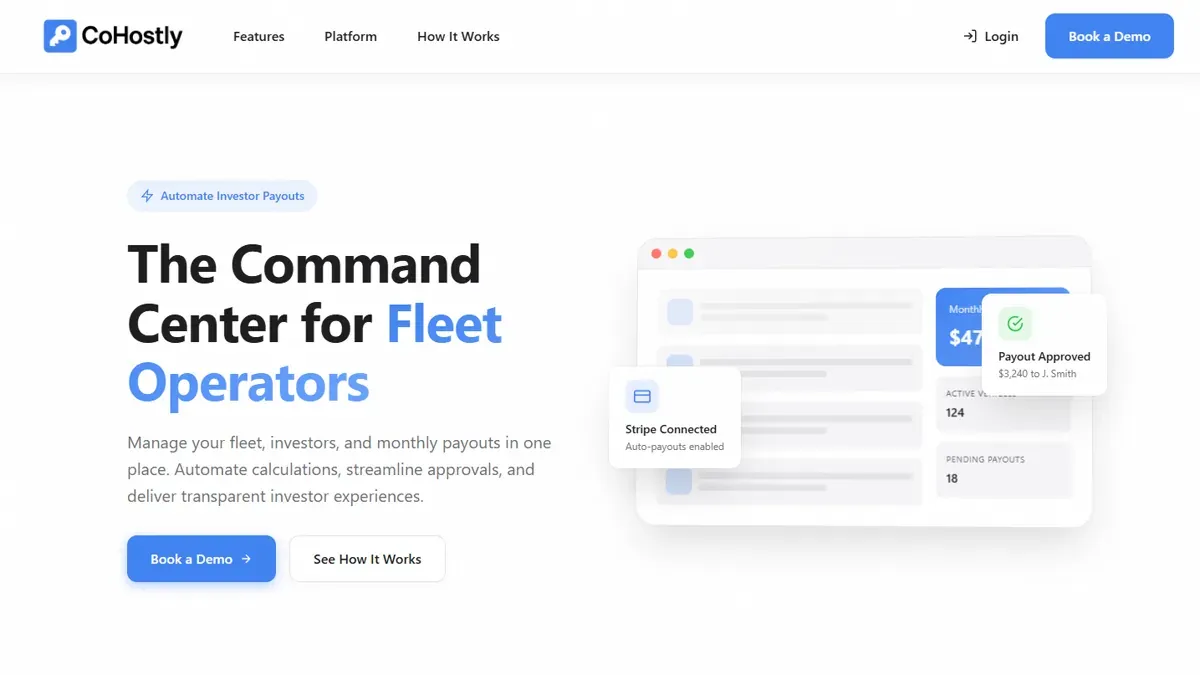
A growing hospitality management company needed to coordinate cleaners, track property status across dozens of rentals, manage guest communications, and handle owner reporting—all in one place. Existing solutions like Guesty and Hostaway covered booking management but fell short on fleet coordination and real-time task assignment.
We built CoHostly as a custom web application with real-time dashboards, automated task routing, integrated payment processing through Stripe, and owner-facing reports. The platform now manages hundreds of properties with a fraction of the administrative overhead.
Learn more about CoHostly →Training HQ — Custom Fitness & Training Platform
A fitness business needed a platform that combined workout programming, client progress tracking, nutrition planning, and billing—with a branded experience they controlled. Generic fitness apps like TrueCoach handled programming but couldn't integrate with their specific assessment protocols and billing workflow.
We built Training HQ as a full-featured web and mobile platform with custom workout builders, progress analytics, nutrition tracking, and integrated payments. The branded platform became a key differentiator in their market and significantly increased client retention.
Learn more about Training HQ →In both cases, the businesses tried off-the-shelf solutions first and hit limitations that were costing them time, money, and competitive advantage. Custom software solved the problem permanently and became a growth driver rather than just a cost.
Integration & Scalability Considerations
Two often-overlooked factors in the build-vs-buy decision are how well the software integrates with your existing systems and how it scales as your business grows.
Integration Considerations
- Data silos: Off-the-shelf tools often create data silos that require manual export/import or expensive integration middleware. Custom software can be built with unified data architecture from day one
- API limitations: Many SaaS tools restrict API access to higher-tier plans or rate-limit integrations. Custom software gives you unlimited access to your own data
- Vendor lock-in: Once your business data lives inside a SaaS platform, migrating away can be painful and expensive. Custom software means you always own your data
- Workflow automation: Custom software can automate your exact workflows end-to-end. Off-the-shelf tools require third-party automation platforms (Zapier, Make) that add cost and complexity
Scalability Considerations
- Per-seat pricing: Many SaaS tools charge per user. Going from 5 to 50 employees can turn a $150/month tool into $1,500/month. Custom software has no per-seat scaling costs
- Feature limits: As you grow, you'll need advanced features that are often locked behind "Enterprise" pricing tiers. Custom software grows with you without tier-jumping
- Multi-location support: If you're expanding to multiple locations or franchising, custom software can be designed for multi-tenant architecture from the start
- Performance: Custom software can be optimized for your specific data volumes and usage patterns, while shared SaaS platforms may slow down at scale
Decision Framework: Which Is Right for You?
Use this framework to evaluate whether custom software or off-the-shelf tools are the better fit for your business right now. Answer honestly—there's no wrong answer, only the right fit for your current stage.
Choose Off-the-Shelf If...
- Your processes follow standard industry workflows
- You have fewer than 10 employees
- Your annual software budget is under $10,000
- You need a solution working within days, not months
- A single SaaS tool covers 80%+ of your needs
- You're still figuring out what your ideal workflow looks like
Choose Custom Software If...
- No existing tool fits your workflow without major workarounds
- You're paying for 4+ SaaS tools that should be one platform
- Your software is (or could be) a competitive advantage
- You need deep integrations between systems
- Per-seat pricing is becoming a significant cost as you grow
- Data ownership and security are critical requirements
Consider a Hybrid Approach If...
- Some needs are standard (accounting, email) while others are unique (client portal, operations)
- You want to start with off-the-shelf and build custom for your core differentiator
- You need to prove a concept before investing in full custom development
- Budget allows for phased development—build the most critical custom piece first
Not Sure Where You Fit?
We help businesses evaluate their software needs every day. Whether you need a custom platform, a better website, or just honest advice about which tools to use, we're happy to talk through your options. Schedule a free consultation and let's figure out the right path for your business.